
LED Light for Fluorescence Excitation
microscopy and gel documentation
Long-life, low-heat and energy-efficient LED light sources are useful for fluorescence excitation in laboratory observation, microscope imaging and gel documentation workflows.
Mecan USA offers LED transmitted light sources, flexible LED epi-lights, handheld LED flashlights, microscope filter holder options and reagent guidance. Suitable wavelength and filter selection should be matched to the fluorescent dye, sample and imaging setup.

LED Fluorescence Excitation Product Lineup

LED transmitted light sources for fluorescent samples, microscope observation and gel documentation workflows. They can be selected according to the sample, dye and wavelength requirement.

Flexible double-arm LED epi-light for macro and microscope observation. Useful when top illumination angle and working distance must be adjusted around the specimen.

Handheld LED flashlights with wavelength options from UV to IR. Useful for quick fluorescence checking, field observation and simple optical inspection.
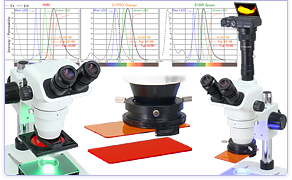
Filter holder options for building a simple fluorescence observation setup with a stereo microscope or imaging system. Proper excitation and emission filter matching is required.
LED Light Sources for Fluorescence Observation
|
|
How to Choose
Use the steps below as a starting point for selecting a suitable LED fluorescence excitation setup.
- STEP 1 — Check the reagent and excitation wavelength. Look up your reagent or fluorophore in the Reagent Guide to find a suitable excitation wavelength.
- STEP 2 — Review the illumination options. Mecan USA offers transmitted LED fluorescence excitation (TR8W, DF36W, TR60W) and epi LED fluorescence excitation (HDA, SDA) for use with existing compatible stereo microscopes; review each product line based on your setup and observation requirements.
- STEP 3 — Confirm filter requirements. Fluorescence observation requires a suitable emission filter matched to the light source and reagent. Some models include a filter, while others are used with a separate microscope filter holder, as described on each product page.
Filter and Reagent Support
When selecting an LED light source for fluorescence excitation, the reagent, wavelength and filter combination should be checked together. The filter guide below can help narrow down suitable combinations for gel documentation and fluorescence imaging applications.
LED Color Selection Guide