
MRV-SNR Polariscope Strain Viewer
(Senarmont Method)
MRV-SNR is a Senarmont method polariscope designed to visually observe strain and compare relative strain conditions in transparent or translucent materials. It is suitable for quality control, process control, R&D comparison and optical component inspection.
The system combines an A4-size LED polarized lightbox, a rotary analyzer with quarter-wave plate, a close-up stand and an evaluation table. Camera and smartphone configurations are available for documentation and shared observation.
MRV-SNR Standard System
 |
Notice:The image shows a digital camera set configuration. FAS200 distortion standard is sold separately and is not included.
|
System Composition & Price
| Product | Rainbow Viewer SNR (Senarmont Set) |
|---|---|
| Item Code | MRV-SNR |
| Price | US$ 2,170 |
  |

|
Digital Camera System - Canon G7X Mark III / Olympus TG-7 / MRV-FH Filter Set
| Set Code | Price | System Composition | |||
| MRVSNR-G7XM3 | US$ 3,540 | |
 |
||
| MRVSNR-FH-G7XM3 | US$ 3,690 | |
 |
||
| MRVSNR-TG7 | US$ 2,760 |  |
|||
| MRVSNR-FH-TG7 | US$ 3,000 | |
|
||
| Product Code | MRV-SNR | G7XM3-SET | TG7-SET | MRV-FH | |
| Price | US$ 2,170 | US$ 1,280 | US$ 590 | Set price | |
Senarmont Evaluation Method

The FAS200 distortion standard has a numerical strain display and can be used as a reference device for comparative checks with various polariscopes. It is sold separately.
1. Sample Placement
Set the analyzer to the 0-degree position. Rotate the sample until the inspection area becomes brightest.

2. Angle Reading
Rotate the analyzer to find the angle where the inspection area becomes darkest. Use the evaluation table to compare the relative strain condition from the angle.

3. Strain Evaluation
For example, when the darkest point is found at 19°, the strain value is determined as approximately 60.8 by using the strain evaluation table.

Features

Relative Numerical Evaluation for QC and R&D
MRV-SNR supports relative numerical evaluation of distortion and residual strain based on analyzer angle. It is useful for manufacturing quality control, abnormality detection, process comparison and R&D evaluation of transparent materials, while not guaranteeing absolute stress values.
- Plastic and glass material inspection
- Evaluation of optical products such as lenses, mirrors and optical fibers
- Comparison of strain conditions for material design and process control
High-Brightness
A4 LED Polarized Lightbox
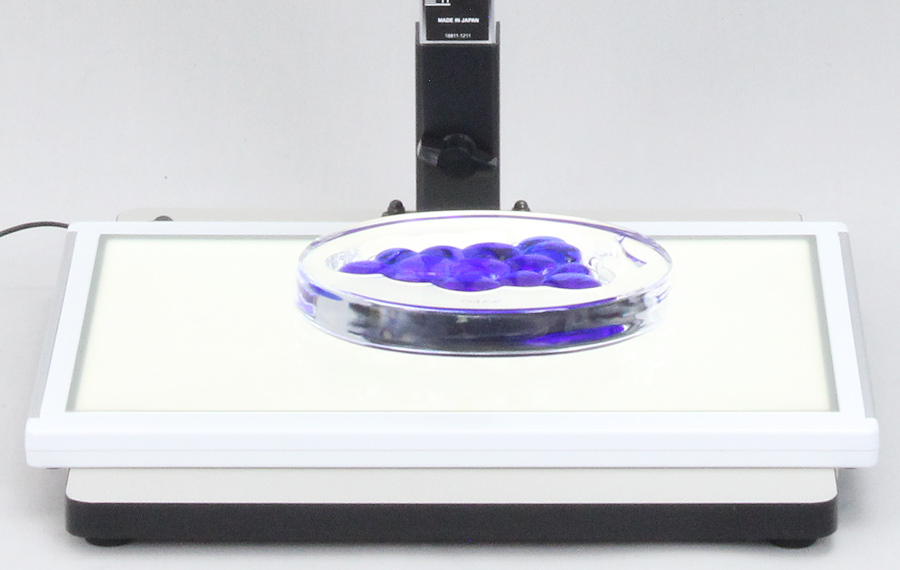
The high-brightness polarized LED lightbox has a large A4-size luminous surface, allowing larger samples to be inspected in their entirety. The LED light source has an approximate lifetime of 40,000 hours.
Optional MRV-FH Filter Set
With the optional MRV-FH filter set, cross Nicols, parallel Nicols and sensitive color method observation can also be performed. This expands MRV-SNR beyond Senarmont comparative evaluation into broader visual strain inspection workflows.
Observation Examples
Typical strain patterns observed using cross Nicols and sensitive color method. Color distribution and fringe patterns allow intuitive comparison of internal stress conditions.
 Cross Nicols / CD Case
 Cross Nicols / Plastic
 Cross Nicols / Glass
 Sensitive Color / Glass
Camera Information

Canon PowerShot G7X Mark III
Recommended when higher imaging sensitivity is needed. The adjustable tilt monitor, large 1-inch sensor and bright F1.8 lens help capture faint bands and subtle strain differences.
Canon Website
Olympus Tough TG-7
Suitable for a simple, rugged and affordable workflow. The TG-7 camera set is useful for practical laboratory and inspection environments.
OM System WebsiteSpecification
| LED Lightbox Luminous Surface | High-contrast linear polarizer, size: 210 x 297 mm |
|---|---|
| Strain Evaluation / Rotary Analyzer | Fixed section: 1/4 retardation plate Rotating part: polarizing plate Diameter: 180 mm Effective diameter: 138 mm |
| Evaluation Method | Senarmont method using rotary analyzer angle and angle-based strain comparison table |
| Working Distance Range | Lightbox to analyzer filter: 100-320 mm adjustable |
| Body Size | Base plate: 300 mm wide x 360 mm deep Pillar height: 574 mm from desktop surface |
| Weight | Body: 2.7 kg / LED lightbox: 1.5 kg |
| Power Supply for Lightbox | Input: AC 100-240 V, 50/60 Hz universal Output: DC 12 V, 1 A |