
Polariscope Strain Viewer
for Residual Stress and Birefringence Inspection
Visual strain observation and comparative strain evaluation for transparent materials
Polariscope strain viewers use polarized light to reveal internal strain, residual stress and birefringence patterns in transparent or translucent materials. They are useful for inspecting plastic molded parts, glass, lenses, optical components, films and clear resin products.
The lineup includes MRV-ST for visual strain observation, MRV-SNR for comparative strain evaluation based on the Senarmont method, MRV-MS for magnified polarized-light inspection using a stereo microscope, and MRV-MSL for microscope-based inspection with a large-area flat panel LED for uniform illumination.
Polariscope
Residual Stress
Sensitive Color Method
Senarmont Method
Plastic / Glass
Polariscope Strain Viewer Product Lineup
MRV-ST

Visual · Strain · Cross-Nicols
MRV-ST supports cross Nicols, parallel Nicols and sensitive color method observation. The A4-size light stage and large observation window make it suitable for checking glass distortion, molded plastic parts, clear plates and other wide-area samples.
MRV-ST supports cross Nicols, parallel Nicols and sensitive color method observation. The A4-size light stage and large observation window make it suitable for checking glass distortion, molded plastic parts, clear plates and other wide-area samples.
MRV-SNR
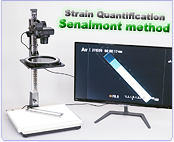
Senarmont · Comparative · QC
MRV-SNR supports comparative strain evaluation using the Senarmont method. It compares the relative degree of strain between samples numerically, making it useful for QC, process control and sharing inspection data with customers or suppliers.
MRV-SNR supports comparative strain evaluation using the Senarmont method. It compares the relative degree of strain between samples numerically, making it useful for QC, process control and sharing inspection data with customers or suppliers.
MRV-MS
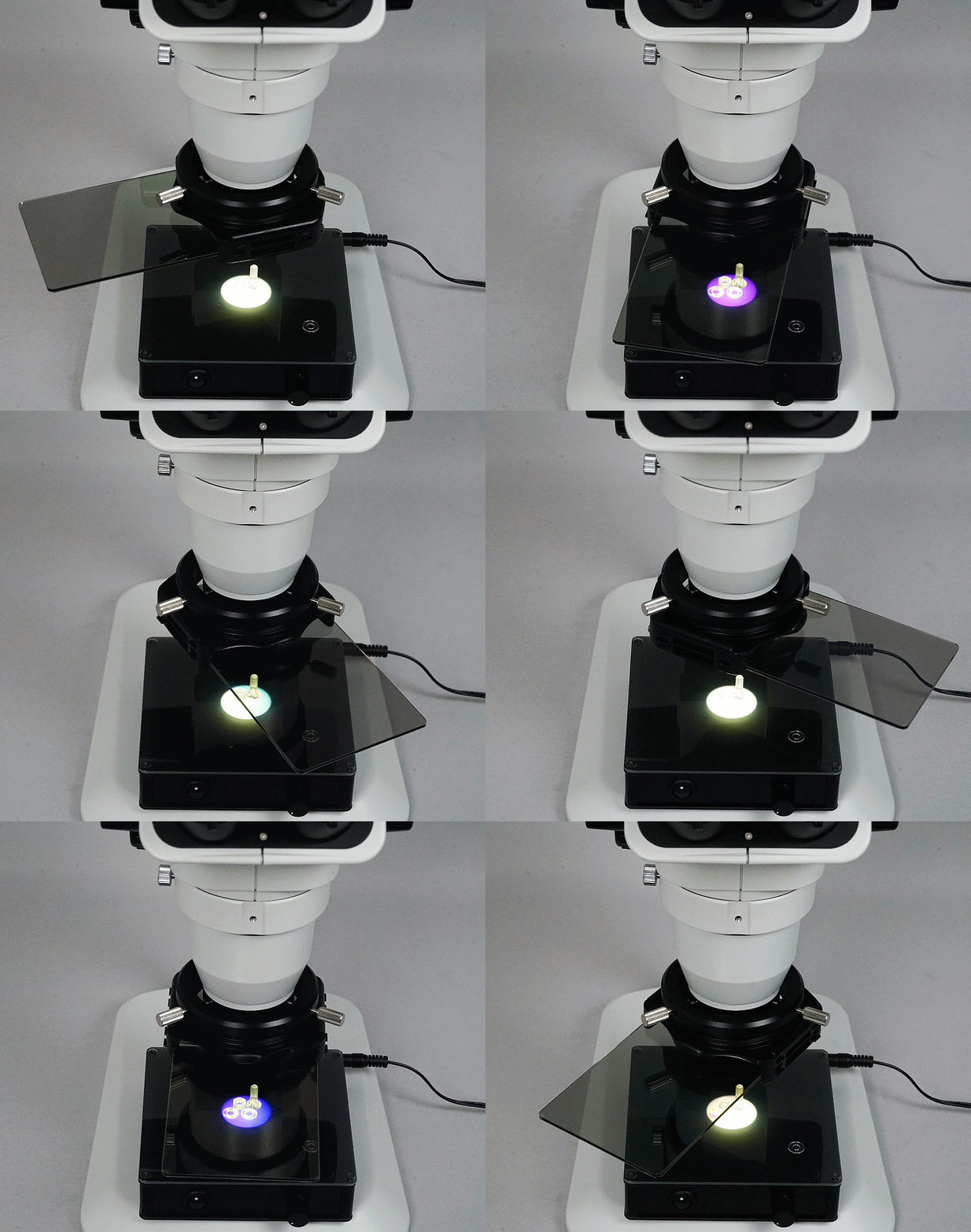
Stereo Microscope · Polariscope
MRV-MS upgrades an existing stereo microscope into a polarized strain inspection system, supporting crossed-Nicols, parallel-Nicols and sensitive color observation under magnification for small transparent parts and optical components.
MRV-MS upgrades an existing stereo microscope into a polarized strain inspection system, supporting crossed-Nicols, parallel-Nicols and sensitive color observation under magnification for small transparent parts and optical components.
MRV-MSL
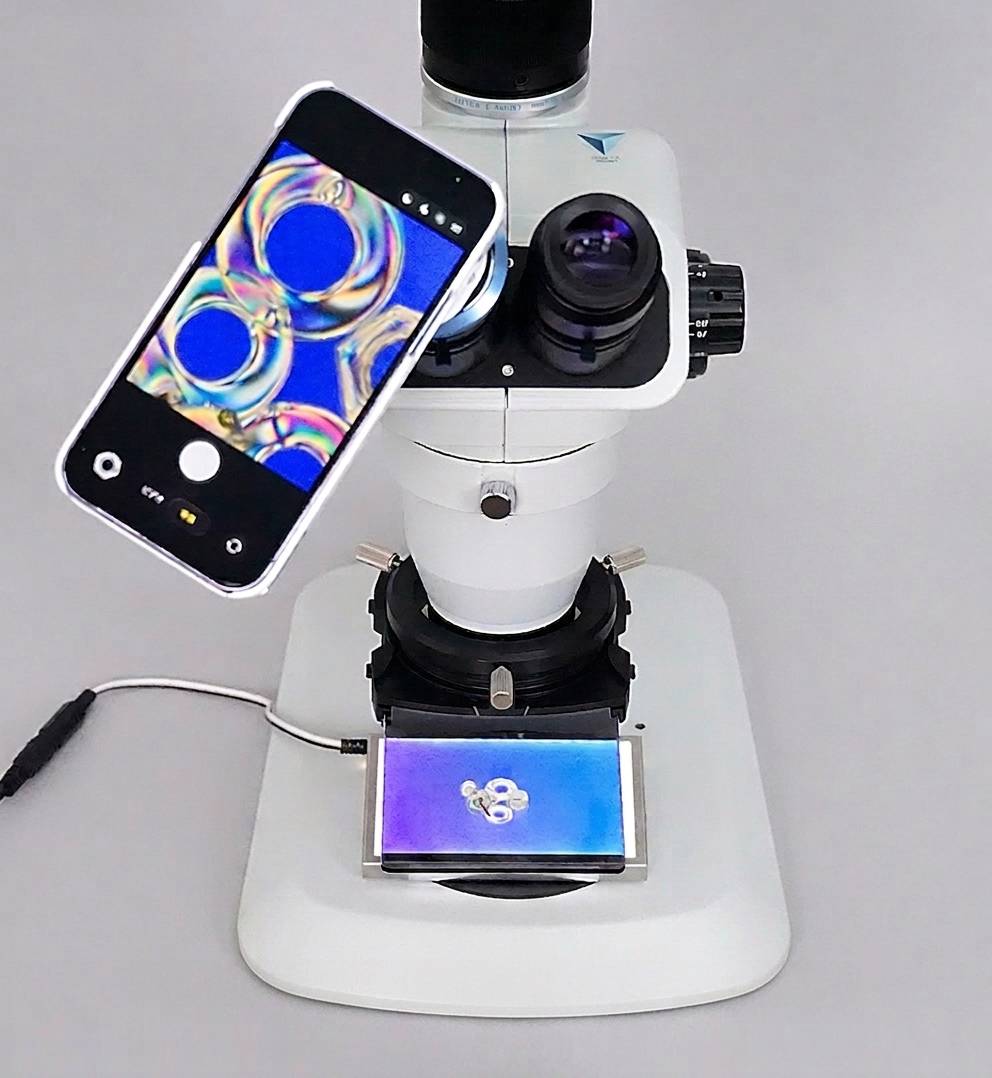
Stereo Microscope · Flat Panel LED
MRV-MSL features a large-area flat panel LED light source for uniform polarized illumination across the entire field of view, supporting crossed-Nicols, parallel-Nicols and sensitive color observation under magnification.
MRV-MSL features a large-area flat panel LED light source for uniform polarized illumination across the entire field of view, supporting crossed-Nicols, parallel-Nicols and sensitive color observation under magnification.
Polarized-Light Inspection for Strain and Optical Distortion
|
|
Which Polariscope Strain Viewer Should I Choose?
|
|
|
|
Need help selecting a strain viewer?
Please tell us your sample material, size, thickness, inspection purpose
and whether relative strain comparison is required.
Please tell us your sample material, size, thickness, inspection purpose
and whether relative strain comparison is required.
Typical Inspection Applications
|
|
Note: Polariscope observation results depend on material transparency, thickness, stress condition, optical setup and inspection environment. MRV-SNR is intended for comparative strain evaluation and relative numerical comparison, not as a guarantee of absolute stress values.
FAQ — Polariscope Strain Viewer
Q
What is a polariscope strain viewer?
▼
A
A polariscope strain viewer is an optical inspection device that uses polarized light to visualize internal strain, residual stress, and birefringence patterns in transparent or translucent materials.
Q
What is the difference between MRV-ST and MRV-SNR?
▼
A
MRV-ST is suitable for visual strain observation using crossed-Nicols, parallel-Nicols, and sensitive color methods. MRV-SNR supports comparative strain evaluation based on the Senarmont method, helping compare relative strain or distortion differences between samples.
Q
Does MRV-SNR provide absolute stress values?
▼
A
MRV-SNR is intended for comparative and semi-quantitative strain evaluation. It helps compare relative differences in strain or distortion between samples, rather than guaranteeing an absolute stress value.
Q
Which materials can be inspected?
▼
A
Typical inspection targets include molded plastic parts, glass, lenses, transparent films, optical components, and other materials that show birefringence or stress patterns under polarized light.
Q
What is a stereo microscope polariscope?
▼
A
A stereo microscope polariscope is a polariscope system designed to attach to a stereo microscope, enabling magnified strain observation of small parts and localized areas. It is ideal for inspecting small molded plastic components, optical elements, and fine features that are difficult to evaluate with a standard light-stage polariscope.
Q
How does a stereo microscope polariscope differ from a standard polariscope?
▼
A
A standard polariscope (such as MRV-ST) uses a large light stage for viewing samples directly with the naked eye. A stereo microscope polariscope (MRV-MS / MRV-MSL) attaches to a stereo microscope to provide magnified polarized-light observation, making it suitable for small or detailed samples.