
Full Frame DSLR Microscope Adapter - NY-1S35
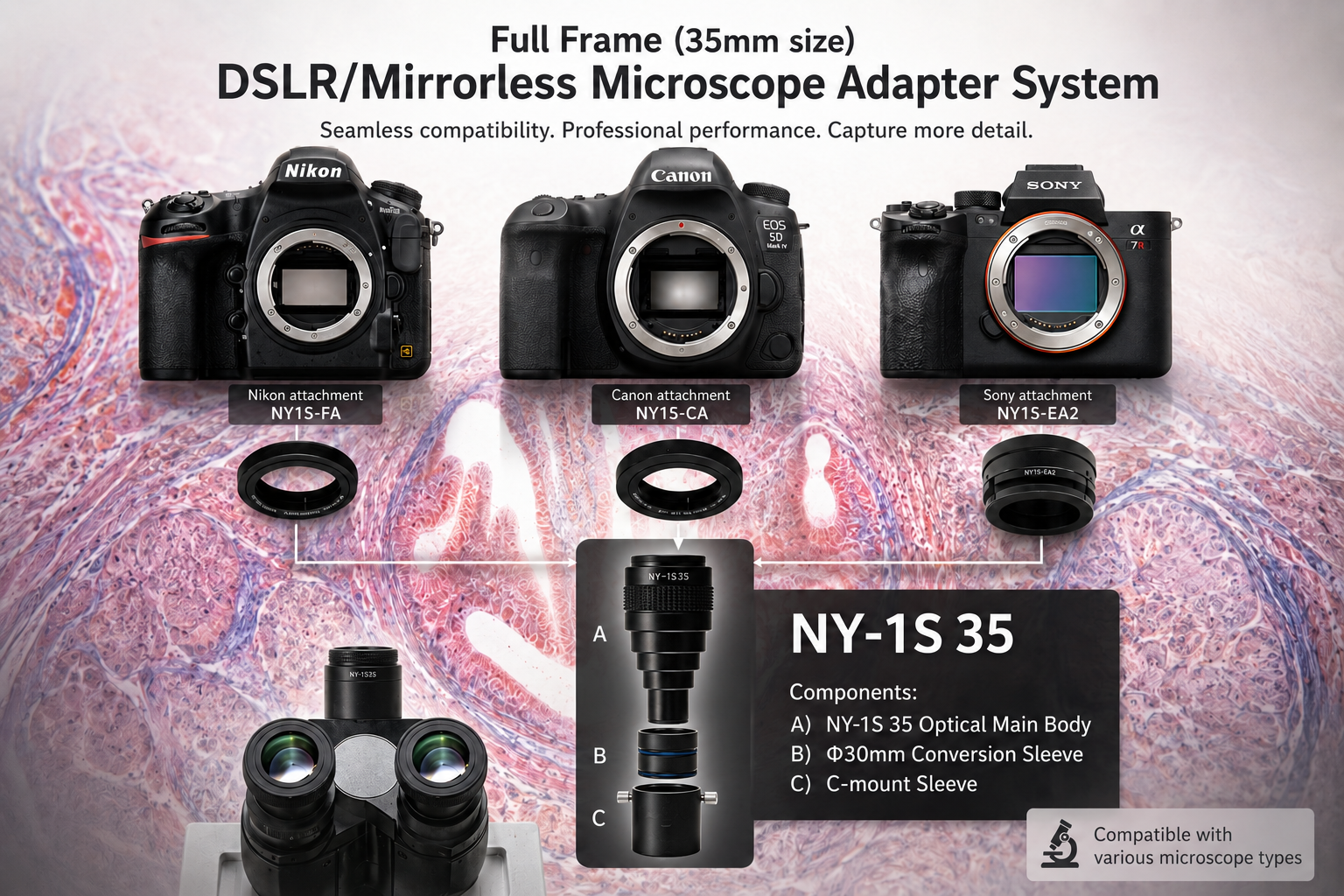
NY-1S35 is a relay-lens microscope adapter designed for 35mm full-frame
DSLR and mirrorless cameras. Its optical system is optimized for full-frame
image sensors to provide practical image coverage for high-resolution microscope
photography and documentation.
It connects interchangeable-lens camera
bodies to microscopes for photography,
video recording, inspection and
imaging workflows when the camera mount and
microscope-side connection
are properly matched.
NY-1S35 — Price
| Product | Model | Price |  |
|---|---|---|---|
| Full-Frame DSLR Microscope Adapter | NY-1S35 | US$ 720 |
Camera Mount Attachments
| Attachment for DSLR Models | Model | Price |
|---|---|---|
| Canon EOS attachment | NY1S-CA | US$ 34 |
| Nikon F-mount attachment | NY1S-FA | US$ 34 |
| Sony α, Minolta, Konica Minolta attachment | NY1S-αA | US$ 34 |
| Olympus Four Thirds attachment | NY1S-OFA | US$ 34 |
| Olympus OM-mount attachment | NY1S-OMA | US$ 34 |
| Pentax attachment | NY1S-PA | US$ 34 |
| Attachment for Mirrorless Models | Model | Price |
|---|---|---|
| Canon mirrorless attachment | NY1S-CMA | US$ 60 |
| Nikon mirrorless attachment | NY1S-N1A | US$ 60 |
| Sony NEX / E-mount attachment | NY1S-EA | US$ 60 |
| Micro Four Thirds attachment | NY1S-MOFA | US$ 60 |
| Pentax Q-mount attachment | NY1S-QA | US$ 60 |
| Canon R series attachment set (NY1S-CA + EF-R) | NY1S-PRA | US$ 205 |
| Nikon Z series attachment set (NY1S-FA + F-Z) | NY1S-PZA | US$ 122 |

attachment

attachment
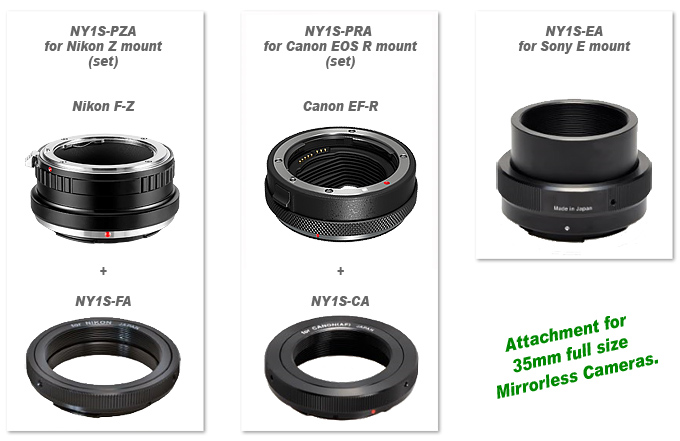
attachment set
Optional Microscope-Side Items
| Optional Item | Model | Price |
|---|---|---|
| JIS standard phototube sleeve | NY-JIS | US$ 53 |
| Olympus PT type phototube sleeve | NY-BH | US$ 53 |
Key Features of NY-1S35
Designed for 35mm Full-Frame Sensors
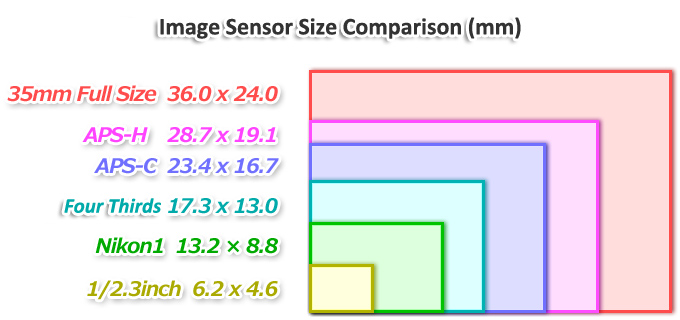
A full-frame DSLR or mirrorless camera uses a 35mm full-frame image sensor that is significantly larger than a typical APS-C sensor. The larger sensor area can provide higher image quality, smoother tonal gradation and improved detail reproduction for high-resolution microscope imaging applications.
Relay-Lens Design for Full-Frame Microscope Imaging
The built-in relay-lens optical system is optimized for 35mm full-frame DSLR and mirrorless camera sensors. It helps project the microscope image to the camera sensor more effectively than simple mechanical-only coupling methods. Actual image coverage and edge performance depend on the microscope optical path, objective lens and camera format.

Low-Vibration Imaging with Mirrorless Cameras
Mirrorless cameras operate without a mechanical reflex mirror, helping reduce vibration during image capture. This can minimize camera-induced blur and makes mirrorless full-frame systems well suited for high-resolution microscope photography and documentation.

Sample Image Quality
NY-1S35 is suitable for high-resolution microscope imaging when the microscope and camera system are properly matched. It is used for research, education, documentation and industrial inspection workflows.

Compatible Microscope Applications
|
|


Related Setup and Support Pages
|