
LED470-TR60W
470 nm High-Power Blue LED Transilluminator
The LED470-TR60W is a high-power 470 nm blue LED transilluminator designed for safe, UV-free fluorescence gel imaging and gel cutting.
It provides strong excitation for blue-light excitable nucleic acid stains and helps visualize weak DNA/RNA bands with high brightness.
This model uses direct illumination from below. Compared with dark-field models, it emphasizes brightness and cutting workability, making it suitable when stronger excitation power is required.
LED470-TR60W

|
|
Set Composition & Price

|
|
| Product | Item Code | Price |
|---|---|---|
| LED Transilluminator (470 nm) | LED470-TR60W | US$ 1,200 |
High-Power Direct Illumination

Super high-power 60W-class output helps detect weak fluorescence bands and provides enough brightness for gel cutting work.
A 25-chip high-power LED array and diffuser plate provide uniform direct illumination from below.
The 470 nm blue LED is a safer alternative to UV, helping reduce sample damage and user exposure risk.
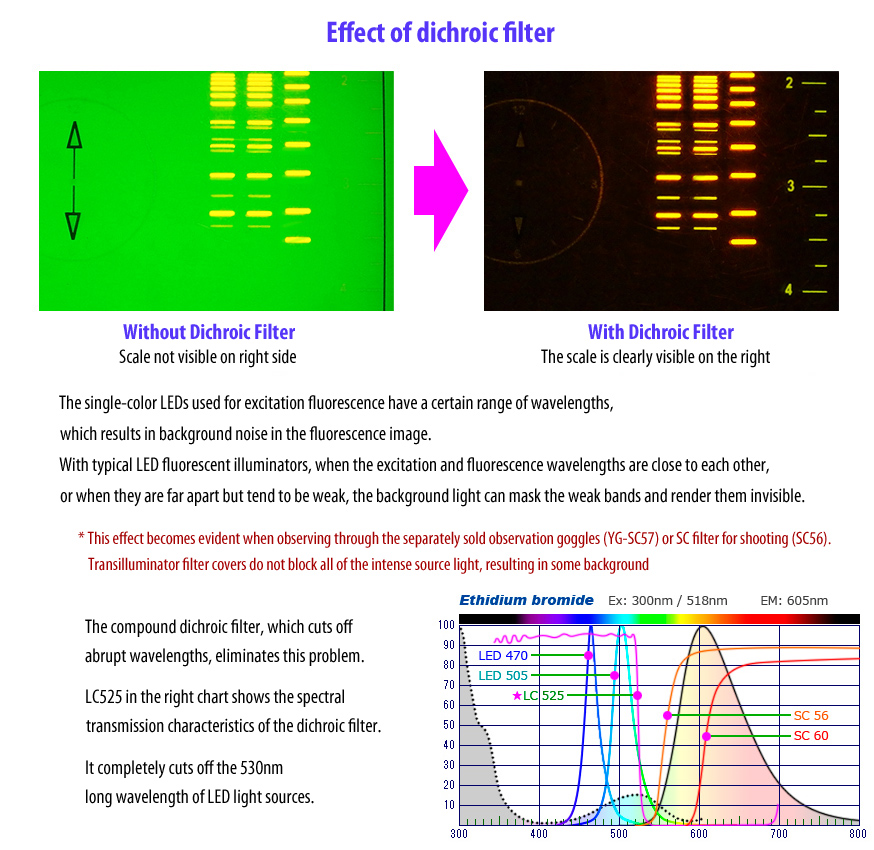
Compound Dichroic Filter
The compound dichroic filter cuts unwanted long-wavelength components from the LED light and helps suppress background glow.
This improves the visibility of faint fluorescence bands, especially in direct-illumination gel imaging workflows.
Auto-Off Function

The auto-off function turns off the transilluminator after approximately 20 minutes, helping prevent gels from drying if the light is accidentally left on.
Continuous operation is also possible by deactivating the auto-off setting.
Large Luminous Surface for Gel Cutting
Luminous surface size: 120 x 130 mm
The 120 x 130 mm luminous area provides a practical working area for gel cutting.
The chemically tempered glass surface is resistant to breakage, supporting safer cutting operations.
Removable Orange Observation Cover

The orange sharp-cut filter cover cuts excitation light below 560 nm and allows safer visual observation during gel cutting.
The cover can be attached and removed easily, and the hinge torque can be adjusted with a screwdriver.
Compatible with Pict LaBox and Bio-Pyramid Mini

Pict LaBox Compatible
The LED470-TR60W can be combined with Pict LaBox for gel observation, gel cutting and image documentation using a digital camera system.
Bio-Pyramid Mini Compatible
A compact gel documentation setup can be built by combining the LED470-TR60W with Bio-Pyramid Mini system.

Related Gel Documentation Resources


Specification
| Peak Wavelength | Blue 470 nm |
|---|---|
| Filter Size / Luminous Area | 130 x 120 mm / 120 x 130 mm luminous surface |
| LED | High-power chip LED x 25, evenly spaced |
| Illumination Method | Direct radiation from below (transilluminator) |
| Surface Filter | Compound dichroic filter. Metallic multi-layer deposition and anti-fluorescence reflective processing. |
| Features | 1. Press and hold switch for 1.5x power (30 sec) 2. Auto-off function (20 min) |
| Observation Cover Filter | Cast acrylic orange cover, cuts off 560 nm or below |
| Compatible Fluorescent Reagents | Recommended for reagents with excitation wavelength around 450-490 nm: SYBR Green, SYBR Safe, GelGreen, Midori Green and similar blue-light excitable nucleic acid stains. |
| Power Supply (AC Adapter) | Input: 100-240V, 50-60Hz universal Output: 24V 2.7A (65W), PSE / UL / CE approved |
| Power Consumption | Normal setting: 39W / High-power setting: 58.5W |
| Lamp Life | 40,000 hours (estimated calculation time) |
| Cooling | Micro fan, forced-air cooling system |
| Accessories | AC-DC adapter, orange observation filter cover |
| Body Size / Weight | W290 mm x D230 mm x H81 mm (H99 mm with filter cover) 1.8 kg |
| Size & Dimension |  |
| Part Names & Functions |  |
FAQ
What is LED470-TR60W used for?
It is used for UV-free fluorescence gel imaging and gel cutting using 470 nm blue-light excitation.
Which stains are suitable for LED470-TR60W?
It is suitable for blue-light excitable stains such as SYBR Green, SYBR
Safe,
GelGreen, Midori Green and similar dyes around 450-490 nm.
Should I choose 470 nm or 505 nm?
Choose 470 nm for SYBR Green, SYBR Safe, GelGreen and Midori Green.
Choose 505 nm for EtBr, GelRed and SYBR Gold.
What is the difference between DF36W and TR60W?
DF36W is a dark-field model designed for low-background observation.
TR60W is a direct-illumination high-power model designed for brighter excitation
and gel cutting.
470 nm vs 505 nm Selection Guide
| 470 nm Model | 505 nm Model | |
|---|---|---|
| Excitation wavelength | 470 nm blue LED | 505 nm blue-green LED |
| Recommended stains | SYBR Green / SYBR Safe / GelGreen / Midori Green | EtBr / GelRed / SYBR Gold and similar longer-wavelength excitable stains |
| Main selection point | Choose when your fluorescent stain has strong excitation around 450–490 nm. | Choose when your fluorescent stain has better excitation around 500–520 nm. |
| Safety note | Both models use visible LED excitation and are UV-free alternatives for gel imaging. The best model should be selected based on the excitation characteristics of the fluorescent reagent. | |
gel size and camera system.