
Microscope Lighting
Mecan USA offers microscope lighting options for stereo microscope inspection, transmitted-light observation and fluorescence excitation applications.
The appropriate illuminator depends on the sample surface, transparency, required contrast, working distance and observation method. This page provides an overview of the main lighting groups available for practical microscope workflows.
Microscope Lighting Lineup

LED ring lights, LED twin-arm lights, and fiber-optic style illumination options for surface observation, inspection, and general stereo microscope work.
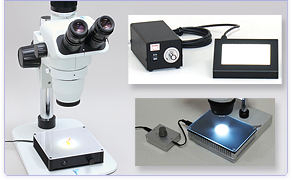
Compact transmitted-light units can be placed on the microscope stage for brightfield-style observation of transparent or semi-transparent specimens.

Single-wavelength LED light sources are available in transmitted, epi, twin-arm, and flashlight-style configurations for fluorescence excitation applications.
Choose Lighting by Observation Method
|
|
Selection Notes
| Lighting Type | Main Use | Typical Selection Point |
|---|---|---|
| LED Epi-Illuminator | Reflected-light observation of opaque samples and surfaces. | Choose by required brightness, working distance, light angle and whether even or directional illumination is preferred. |
| LED Transmitted Light | Observation of transparent or translucent samples from below. | Choose by illumination area, brightness, sample size and compatibility with the microscope stage. |
| LED Fluorescence Excitation | Fluorescence excitation using selected LED wavelengths. | Confirm excitation wavelength, emission filter, sample fluorescence and optical configuration before selection. |
Note: For fluorescence applications, the LED wavelength, excitation filter, emission filter and sample/reagent characteristics should be checked together.