
LED Illuminator for Fluorescence Excitation
LED transmitted and reflected-light excitation systems for
stereo microscope fluorescence observation.
These LED excitation systems help enable fluorescence observation on a standard stereo microscope. Select transmitted excitation from below the stage, or reflected / twin-arm excitation from above or from the side, depending on the sample, reagent, working distance and filter configuration.
Typical applications include GFP observation, EtBr gel imaging, Cy3 fluorescence observation and general fluorescence screening workflows.
Blue / Green LED Excitation
Transmitted Light
Twin-Arm Epi Light
Filter Holder Options
LED Fluorescence Excitation Lineup
LED Transmitted Illuminator
TR8W Series
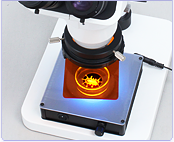
Transmitted excitation
LED470-TR8W
LED505-TR8W
High-power LED transmitted illuminator for fluorescence
excitation observation on a stereo microscope.
LED505-TR8W
LED Epi-Illuminator
HDA Series

Twin-arm epi excitation
HDA-TB3
HDA-TG3
LED twin-arm excitation light for reflected fluorescence
observation with adjustable incident angle.
HDA-TG3
SDA-B4 / C4
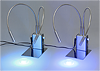
Compact twin-arm type
SDA-B4
SDA-C4
Blue or green LED twin-arm excitation type for compact
fluorescence observation setups.
SDA-C4
Filter Holder Systems
MFH-FL
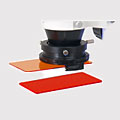
Filter holder
Filter holder option for fluorescence and observation setups using compatible stereo microscopes.
Filter holder option for fluorescence and observation setups using compatible stereo microscopes.
LFH-FL
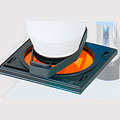
Large filter holder
Filter holder option for fluorescence observation setups where larger stage or base compatibility is required.
Filter holder option for fluorescence observation setups where larger stage or base compatibility is required.
Filter Guide

Filter reference
Guide information for selecting filter combinations used in fluorescence observation workflows.
Guide information for selecting filter combinations used in fluorescence observation workflows.
Selection Guide
Transmitted excitation
Use transmitted LED excitation when the sample or gel can be illuminated from below. This approach is useful for many transparent, translucent or gel-based fluorescence observation workflows.Epi / reflected excitation
Use LED twin-arm excitation when lighting from above or from the side is preferred, especially when the incident angle needs to be adjusted or when the sample is not suitable for transmitted illumination.
Filter note: Fluorescence observation
normally requires an appropriate excitation and observation
filter combination. Actual visibility depends on the
fluorescent reagent, excitation wavelength, sample brightness,
microscope optics and ambient-light conditions.