
Anti-Reflective Acrylic Sheet
Cast Type AR Acrylic
High-clarity cast acrylic sheet with a precision multi-layer anti-reflective
coating.
It reduces surface reflection while maintaining excellent transparency,
making it suitable for display showcases, museum frames, inspection windows,
monitor protection, and optical applications.
Unlike anti-glare materials that diffuse reflections, anti-reflective acrylic is designed
to reduce reflected light at the surface. This helps viewers see the object
or
image behind the panel with greater clarity.
ARAC1003 / ARAC603 - Anti-Reflective Acrylic Sheet
with Hydrophobic Coating on Both Sides

|
|
| Item Code | Size | Effective Area | Unit Price |
|---|---|---|---|
| ARAC1003 | 970 x 570 mm | t = 3 mm | 940 x 540 mm | $506 |
| ARAC603 | 570 x 485 mm | t = 3 mm | 540 x 470 mm | $267 |
* Bulk pricing is available for orders of more than 10 units.
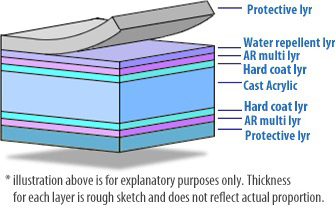
ARAC500 / ARAC380 - Anti-Reflective Acrylic Sheet
with Hydrophobic Coating on One Side
|
|
| Item Code | Size | Effective Area | Unit Price |
|---|---|---|---|
| ARAC500 | 500 x 385 mm | t = 2 mm | 486 x 371 mm | $153 |
| ARAC380 | 380 x 310 mm | t = 2 mm | 366 x 296 mm | $87 |
* Bulk pricing is available for orders of more than 10 units.
Why Use Anti-Reflective Acrylic?
Clearer VisibilityAR acrylic reduces reflected light at the surface, helping objects, images, and displays behind the panel remain clear and easy to see. |
Different from AGAnti-glare materials diffuse light to make reflections less sharp. AR coating reduces reflection itself, so image clarity is better preserved. |
Lighter than GlassAcrylic is lighter and easier to process than glass, making it suitable for showcases, panels, prototypes, and protective covers. |
| Recommended Applications | Display showcases, museum frames, picture frames, optical inspection windows, protective covers for displays, and visual presentation panels. |
|---|---|
| Important Handling Note | The AR coating is a functional surface. Please avoid abrasive cleaning, strong solvents, and unnecessary rubbing. |
How to Cut Acrylic
|
Easy to cut with an acrylic cutter
Score the acrylic surface repeatedly with an acrylic cutter. When the groove reaches approximately one-third of the sheet thickness, place the sheet along the edge of a desk and snap it carefully. 
|
Specification & Inspection Criteria
| Optical Characteristic | 
|
|---|---|
| Standard Reflectance Value | Bottom value: Less than 0.5% Measuring method: One-side coated sample, reverse side pre-painted black, measured by monitor. |
| Visual Inspection | Inspected under 15W-20W fluorescent light with black background. |
| Damage / Foreign Matter / Pinhole / Bubble | Defects greater than 0.3 mm square are not allowed. Defects less than 0.3 mm square: N/A. * Defect size refers to core size. |
| Burn / Dirt | Allowed if not visible under ceiling light. |
| Fingerprint Mark | Not allowed. |
| Interference Color | Purple to violet-blue. |
| Adhesion | Cross-hatch tape-peeling method. Method: Tape peeling test using Nichiban #405. Grid size is approximately 1 mm. Judging criteria: Approved if there is no separation. |
|---|---|
| Coating Hardness | Steel-wool method. Method: Rub with No.0000 steel wool 5 times in both directions using a 1.5 kg load. Judging criteria: Approved if scratch lines are less than 30. |
| Hydrophobic Characteristic | Judging criteria: Hydrophobic behavior is confirmed on the treated side when distilled water is dropped. |
* Defect detection method is based on the “Dirt Comparison Chart”
issued by the Ministry of Finance in Japan.