




















AR / AGAR Film - Mechanism and Effect
AR film reduces mirror-like surface reflection by optical interference.
AGAR film combines anti-reflection with anti-glare diffusion to reduce both reflection and sharp glare.
AR film is suitable when high transparency and clear see-through visibility are important, such as glass windows, showcases, acrylic covers, and protective panels.
AGAR film is suitable for LCD displays, touch panels, framed screens, and similar front-surface applications where glare reduction is also needed.
AR Film Mechanism: How Anti-Reflective Film Works
AR film uses multilayer dielectric coatings to reduce reflection by optical interference. Reflected light from different layer boundaries interferes destructively, which lowers visible surface reflection.
In practical terms, this improves visibility through glass, acrylic, and transparent protective surfaces by reducing the mirror-like reflection caused by ambient light.
 |
Multilayer coatings reduce reflection by causing reflected waves to cancel each other through destructive interference.

|
Effect of AR Film: Reducing Surface Reflection
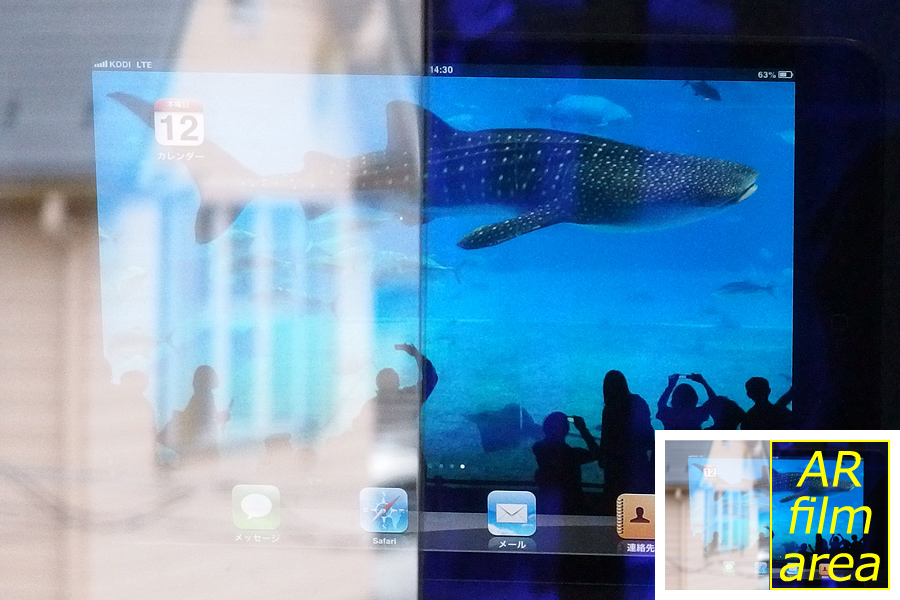
Strong reflections from large windows, showcases, protective covers, or display surfaces can reduce visibility and create an unwanted mirror effect. AR film helps reduce this reflection and makes the object behind the surface easier to see.
This is especially useful when the purpose is to maintain clear visibility through a window, acrylic protective cover, or front panel without distracting reflections from the surrounding environment.

AR Film on One Side or Both Sides?
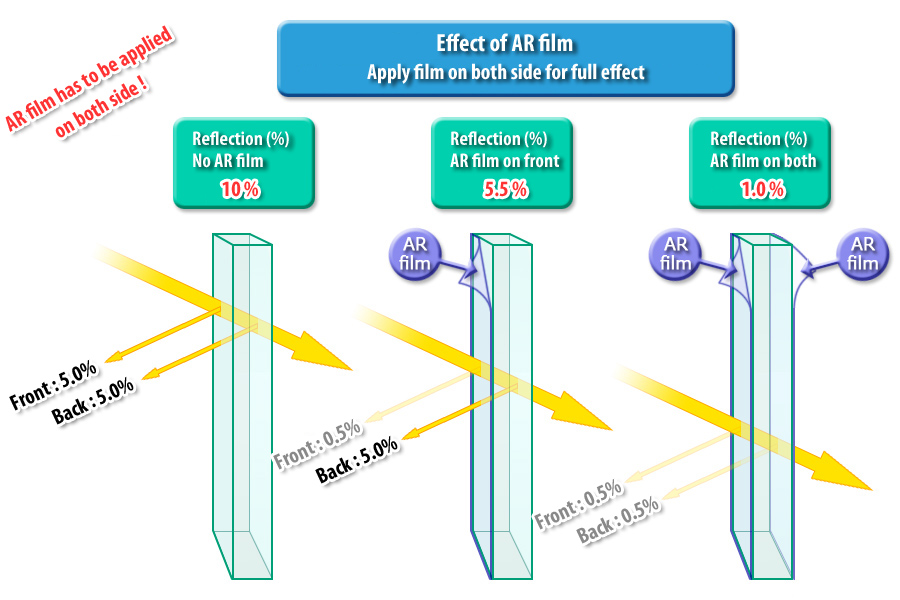
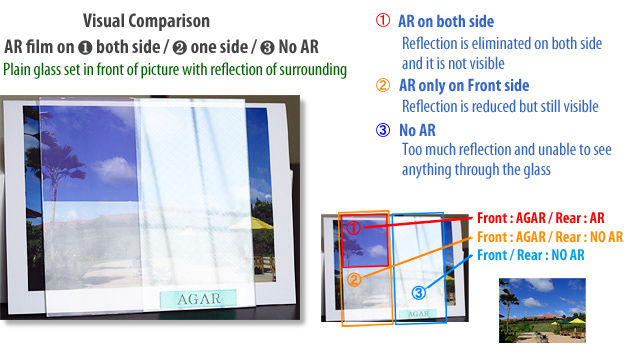
For free-standing transparent materials such as glass or acrylic sheets, light reflects at both the front and rear surfaces. To obtain the strongest anti-reflective effect, AR film should be applied to both sides when possible.
Untreated glass typically reflects about 4-5% per surface. That means roughly 10% total reflection from both sides combined. If AR film reduces each treated surface to about 0.5%, then both-side application can reduce total reflection to around 1%.
Applying AR film to only one side still leaves reflection from the untreated surface, so the improvement is only partial.
| Condition | Front Reflection | Back Reflection | Total Reflection |
| No AR film | 5.0% | 5.0% | 10.0% |
| Front side only | 0.5% | 5.0% | 5.5% |
| Both sides | 0.5% | 0.5% | 1.0% |
Limited Effect on Double-Pane and Triple-Pane Glass
Double-pane and triple-pane glass contain multiple reflective interfaces. To fully suppress reflection, every relevant surface would need to be treated.
In practice, this is difficult because the internal sealed surfaces are not accessible. For that reason, AR film is generally not recommended when the main goal is to eliminate reflections from multi-pane insulated glass.
For example, double-pane glass has four reflective surfaces. Treating only the accessible outside surfaces still leaves reflection from the internal surfaces.

LCD Displays Often Need Film Only on the Front Surface
Surface reflection occurs at interfaces where there is a difference in refractive index, such as between air and glass.
In many displays, the rear side of the front cover is optically bonded with adhesive and has no air gap. Because of this, applying AR film or AGAR film to the front surface alone is often sufficient to achieve a useful reduction in reflection.
Actual effectiveness depends on the display structure and the specific model, but optically bonded displays are usually more favorable than ordinary free-standing glass sheets.

AGAR Film: Anti-Glare + Anti-Reflective
AGAR film combines anti-reflective coating with anti-glare surface diffusion treatment. Compared with standard AR film, it not only reduces mirror-like reflection but also suppresses sharp highlights from direct light sources.
This makes AGAR film effective for LCD displays, touch panels, picture frames, and similar applications where the viewing target is close to the film surface or there is little to no air gap behind the front surface.
However, because AGAR film diffuses light, objects viewed through the film may appear slightly blurred when they are positioned at a distance behind the glass. For that reason, AGAR film is generally not ideal for shop windows or showcases where maximum see-through clarity is required.
Note: Many low-cost anti-glare films for mobile devices use only AG surface treatment and do not include a true multilayer anti-reflective coating.
 |

|

Outdoor Use: Select Outdoor-Rated AR Products
For outdoor applications, select products explicitly intended for outdoor use. Standard indoor AR film may degrade more quickly when exposed to rain, heat, UV, and other severe environmental conditions.
Outdoor-rated AR film is recommended for the outside surface of store windows and other exposed glazing. In some configurations, standard AR film may still be used on the indoor side because the outer glazing and outer film already reduce part of the UV exposure.
Note: Durability depends strongly on the installation environment, so a universal replacement interval cannot be specified.
Important: Multi-pane glazing remains a limitation outdoors as well. If only the accessible outer surfaces are treated, internal pane reflections still remain.
AR Film - Roll Type
UVAR12 / 15SG-Roll
For large glass surfaces such as store windows, showcases, and architectural glazing. |
AR Acrylic - Durable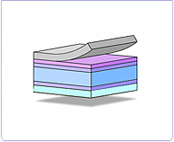
ARAC503T
Durable anti-reflective acrylic for outdoor use and heavy-use environments. |
Tell us your glass structure, display type, indoor/outdoor conditions, size, and installation surface.
Contact us for product selection support
FAQ - AR / AGAR Film
Q. How does AR film reduce reflection?
A. AR film uses multilayer dielectric coatings that reduce reflection by destructive interference between reflected light waves.
Q. Should AR film be applied on one side or both sides?
A. For free-standing transparent materials such as glass or acrylic, both-side application provides the strongest effect because reflection occurs at both surfaces.
Q. Is AR film effective on double-pane or triple-pane glass?
A. Only partially. Multiple internal reflective surfaces remain, so full reflection reduction is difficult unless all relevant surfaces are treated.
Q. Why is front-side application often sufficient for LCD displays?
A. Many display stacks are optically bonded at the rear side of the cover surface, so the main air-glass reflection occurs at the front surface.
Q. What is the difference between AR film and AGAR film?
A. AR film reduces mirror-like reflection, while AGAR film combines anti-reflection with anti-glare diffusion treatment to suppress both reflection and sharp highlights.
See also: AR Film / AGAR Film / How to Apply AR Film