 Top
Top




















Wet-processed anti-reflective acrylic sheets designed to reduce surface reflection while maintaining high transparency and clear visibility. Both extruded and cast acrylic types are available from a single sheet.
These AR acrylic panels are suitable for display showcases, picture frames, acrylic partitions, inspection windows, protective display covers, and general optical applications where reflection reduction and lightweight handling are important.
 |
For applications involving polarizer film or wave retarder film, cast acrylic is recommended. Extruded acrylic is not recommended for optical-film combinations because of its optical strain characteristics. |
 |
|
| Item Code | Size | Thickness | Unit Price |
|---|---|---|---|
| ARAC550W | 550 x 340 mm | t = 2 mm | $69 |
| ARAC378W | 378 x 287 mm | t = 2 mm | $53 |
* Bulk pricing is available for orders of more than 10 units.
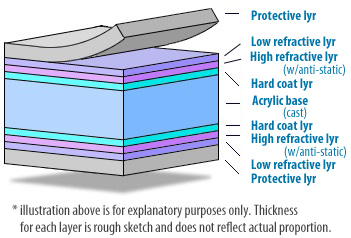 |
|
| Item Code | Size | Thickness | Unit Price |
|---|---|---|---|
| ARAC805CW | 800 x 500 mm | t = 2 mm | $315 |
| ARAC405CW | 500 x 400 mm | t = 2 mm | $168 |
* Bulk pricing is available for orders of more than 10 units.
Extruded TypeRecommended for general display panels, picture frames, partitions, covers, and showcase applications where optical-film combination is not required. |
Cast TypeRecommended when the acrylic sheet may be used together with polarizer film, wave retarder film, or other optical films. |
AR vs. AGAnti-glare materials diffuse reflected light. Anti-reflective coating reduces reflection itself, helping preserve clearer image visibility. |
| Recommended Applications | Display showcases, picture frames, museum-style frames, acrylic partitions, inspection windows, protective covers for displays, and optical prototypes. |
|---|---|
| Important Handling Note | The AR coating is a functional surface. Please avoid abrasive cleaning, strong solvents, and unnecessary rubbing. |
|
Easy to cut with an acrylic cutter
Score the acrylic surface repeatedly with an acrylic cutter. When the groove reaches approximately one-third of the sheet thickness, place the sheet along the edge of a desk and snap it carefully.  |
| Optical Characteristic | 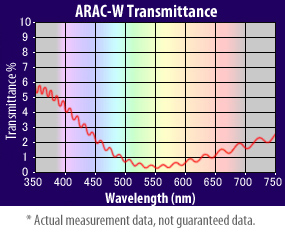 |
|---|---|
| Standard Reflectance Value | Bottom value: less than or equal to 1.5% Measuring method: Measured on a double-sided coated substrate. |
| Visual Inspection | Inspected under 15W-20W fluorescent light with black background. |
| Damage / Foreign Matter / Pinhole / Bubble | Defects larger than 2.0 mm are not allowed. Defects of 2.0 mm or less: N/A. |
| Other interference color non-uniformity and scratches | The defect diameter shall be defined as the area where the interference color differs from that of the normal region. Defects that are easily noticeable by visual inspection after coating are not allowed. |
| Interference Color | Purple to violet-blue. |
| Adhesion | Cross-hatch tape-peeling method. Method: Create a crosshatch pattern of 100 squares at approximately 1 mm intervals on the substrate, then perform three peel tests using Nichiban Cellotape No. 405. Judging criteria: approved if there is no separation. |
|---|---|
| Coating Hardness | Steel-wool method. Method: Using No. 0000 steel wool, apply a 0.5 kg load and rub back and forth five times, then count the number of scratches within a 5 mm width. Judging criteria: approved if scratch lines are less than 20. |
* Defect detection method is based on the “Dirt Comparison Chart”
issued by the Ministry of Finance in Japan.


