Top
Top















A polarizer is an optical filter or material that transmits light vibrating in a specific direction while blocking or absorbing other vibration directions.
Polarized light is light that vibrates in a specific direction.
A polarizing film converts
ordinary light, which vibrates in many directions, into light vibrating mainly in one direction.
This page explains the principles of linear polarizers and circular polarizers,
and shows how polarizers are used in cameras, sunglasses, LCDs, optical
systems,
strain inspection, and polarized 3D.
See also
Linear Polarizer Film,
Circular Polarizer Film,
Wave Retarder Film,
and Sensitive Color Plate.
| Linear Polarizer (Principle and Illustration) |

Ordinary light vibrates in many directions. When that light passes through a linear polarizer, only the component vibrating in the transmission direction passes through, while the orthogonal component is absorbed or blocked.
Because only one polarization component of unpolarized light is transmitted, the theoretical transmittance of an ideal linear polarizer is 50%. In actual products, transmittance is usually lower due to absorption and other optical losses.
This is the basic mechanism behind most linear polarizing films.
| Circular Polarizer (Principle and Illustration) |

A circular polarizer consists of a linear polarizer and a quarter-wave retarder film (1/4 wave plate).
When the slow axis of the quarter-wave plate is aligned at 45° to the absorption axis of the linear polarizer, the transmitted light becomes right-handed circularly polarized light. When aligned at 135° (-45°), it becomes left-handed circularly polarized light.
Circular polarizers are widely used when the optical system requires polarization control without the limitations of simple linear polarizer stacking.

Circular polarizer behavior depends on handedness, stacking direction, and the orientation of the retarder layer. For this reason, circular polarizers are used in optical systems and camera filters where polarization control is needed without the limitations of simple linear polarizer stacking.
| Applications of Polarizers (Polarizing Film) |
Polarizing filters for cameras help control reflected light depending on direction. They are used to suppress glare from water surfaces and window glass, and also to improve perceived color contrast in skies, foliage, and wet surfaces.
Camera PL filters generally use circular polarizers to avoid interference with camera optics and internal prism systems.
 |
 |
Polarized sport sunglasses for driving, fishing, and skiing are designed so that reflected glare from water, roads, and snow is reduced.
By suppressing reflected light, they improve visibility and help the viewer see beneath the water surface or through glare from wet roads and snow fields.

Reflected light from water surfaces tends to become partially polarized. Polarized sunglasses absorb much of this reflected glare, making natural transmitted light easier to observe.
Two polarizers can be combined to adjust transmitted light intensity. By rotating one polarizer relative to the other, the amount of transmitted light changes continuously.
This principle is used in applications such as aircraft windows and variable light-control systems.
LCD panels use polarizers on both the front and back sides. The liquid crystal layer controls optical rotation and birefringence at each pixel, allowing the display to form visible images.
In fiber-optic communication systems, polarization control can be used to improve reliability, reduce noise, and increase channel performance in advanced optical systems.
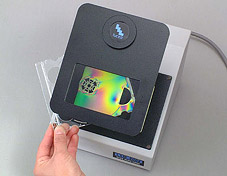
A polariscope is used to visualize internal strain in transparent materials such as plastics and glass. By placing a specimen between polarizers and illuminating it, strain patterns become visible as brightness or color differences.
Typical methods include:
| Method | Description |
| Parallel Nicols | Polarizers are aligned parallel to each other. |
| Cross Nicols | Polarizers are orthogonal to each other for stronger strain contrast. |
| Sensitive Color Method | Useful for materials with relatively low distortion, such as glass. |
The human brain perceives depth from the difference between images seen by the left and right eyes. In polarized 3D systems, two images are projected with different polarizing filters, and special 3D glasses allow the left and right images to be separated and perceived as depth.
|
Images taken from slightly different left and right viewpoints are projected separately. With polarizing filters and matching 3D glasses, each eye receives the intended image, creating a stereoscopic effect. |

|
Q. What is a polarizer?
A. A polarizer is an optical filter or material that transmits light vibrating
in a
specific direction while blocking or absorbing other directions.
Q. What is the difference between linear and circular polarizers?
A. A linear polarizer transmits one vibration direction.
A circular polarizer combines a linear polarizer with a quarter-wave retarder
film
so that the transmitted light becomes circularly polarized.
Q. Why is the theoretical transmittance of a polarizer about 50%?
A. Because unpolarized light contains multiple polarization components,
an ideal linear polarizer transmits only one component.
For this reason, the theoretical transmittance is 50%,
while actual products are usually lower due to absorption and other losses.
Q. What are polarizers used for?
A. Polarizers are used in camera filters, sunglasses, LCDs, optical communication,
strain inspection equipment, and polarized 3D systems.